
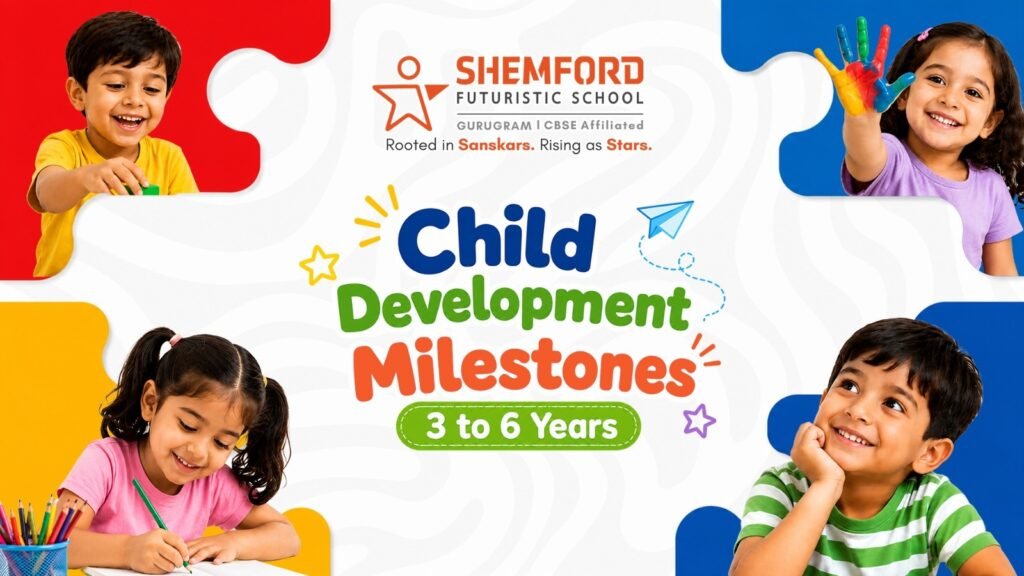
Quick Answer
Between 3 and 6 years, children typically develop clearer speech, longer sentences, better balance and coordination, growing independence in daily tasks, early counting and letter recognition, and more complex play with peers. Every child develops at their own pace, but these age-based patterns help parents know what is generally expected and when to ask a doctor.
Quick Summary for Busy Parents
- Milestones are general patterns, not strict deadlines. Most children reach them within a range of months, not on an exact birthday.
- Language, motor skills, social behaviour, and independence all develop together between ages 3 and 6.
- A consistent, stimulating routine at home and in preschool supports development far more than flashcards or pressure.
- If your child loses a skill they once had, or misses several milestones at once, talk to a paediatrician rather than waiting it out.
- Gurgaon’s early years classrooms, like those at SHEMFORD Gurugram, are structured around these developmental stages.
Introduction
Somewhere between your child’s third and sixth birthday, they go from toddler to a child who can hold a real conversation, make friends on their own, and get themselves dressed most mornings. It is one of the fastest-changing stretches of childhood and one of the most-Googled by parents at 11 pm, wondering whether what they are seeing at home is “normal.”
If you are a parent in Gurgaon trying to make sense of child development milestones between 3 and 6 years, you are not overthinking it. This is genuinely one of the most important windows in early childhood, when language, movement, thinking, and social skills all build on each other. This guide walks through what typically happens at each age, what parents can do to support it, and when it is worth talking to a professional.
Why This Age Range Matters So Much
Between 3 and 6, a child’s brain is developing faster than at almost any other stage of life. This is when foundational skills such as talking in full sentences, managing emotions, following multi-step instructions, holding a pencil, and sharing with other children start to take shape.
It is also the age range when most Gurgaon families are choosing preschools and thinking ahead to Nursery or Kindergarten admissions. Understanding what is developmentally typical helps parents set realistic expectations, notice early signs of a delay, and choose a learning environment that actually matches where their child is.
Milestones by 3 Years
By age 3, most children are moving out of toddlerhood in noticeable ways.
Language and Communication
Most 3-year-olds can speak in short sentences of three to four words, follow two-step instructions such as “pick up your shoes and put them in the box,” and can be understood by people outside the family most of the time.
Movement and Physical Skills
Running, climbing, pedalling a tricycle, and walking up stairs one foot per step are common by this age. Fine motor skills such as turning book pages one at a time and building a small tower of blocks also start to show up.
Social and Emotional Development
Three-year-olds usually begin engaging in simple pretend play, show interest in other children, and can calm down within a few minutes after a parent leaves them at drop-off, although separation can still bring tears.
Thinking and Problem-Solving
Sorting objects by shape or colour, working on simple puzzles, and copying a circle when drawing are typical skills emerging around this age.
Milestones by 4 Years
Four is often when parents notice their child becoming a real conversationalist.
Language and Communication
Sentences get longer and more detailed. Most 4-year-olds can tell a simple story, answer “why” and “how” questions, and use words such as “because” to explain their thinking.
Movement and Physical Skills
Hopping on one foot, catching a bounced ball most of the time, and using scissors to cut along a line are common physical milestones. Fine motor control improves enough for early writing attempts, often including scribbled letters or their name.
Social and Emotional Development
Cooperative play becomes more common, including taking turns, negotiating simple rules with other children, and preferring to play with peers rather than only alongside them.
Thinking and Problem-Solving
Counting a few objects, naming some colours, and understanding the idea of “same” and “different” typically develop around this stage.
Milestones by 5 Years
By 5, many children are getting ready for formal schooling, and their skills reflect that shift.
Language and Communication
Most 5-year-olds speak in clear, complete sentences and can be understood by strangers almost all the time. They can also follow three-step instructions and start to understand basic concepts of time, such as “yesterday” and “tomorrow.”
Movement and Physical Skills
Skipping, balancing briefly on one foot, and drawing a person with several body parts are typical. Fine motor control is usually strong enough to copy simple shapes and some letters.
Social and Emotional Development
Five-year-olds often show more independence by dressing themselves, following classroom-style routines, and showing awareness of other people’s feelings, such as comforting a friend who is upset.
Thinking and Problem-Solving
Counting to ten or beyond, recognising some letters and numbers, and understanding simple mathematical concepts such as “more” and “less” commonly emerge around this age.
Milestones by 6 Years
By 6, most children have moved into early formal learning, and development becomes more visibly academic alongside social growth.
Language and Communication
Vocabulary expands quickly, and most 6-year-olds can retell a story in order, hold a two-way conversation, and start blending sounds to read simple words.
Movement and Physical Skills
Better balance and coordination appear in activities such as riding a bicycle with training wheels, skipping rope, and producing more controlled handwriting.
Social and Emotional Development
Friendships become more meaningful, children begin understanding rules and fairness in games, and most can manage frustration without a full meltdown, at least some of the time.
Thinking and Problem-Solving
Basic addition and subtraction with small numbers, a general understanding of time on a clock, and following longer multi-step instructions are common by this stage.
What Parents in Gurgaon Can Do to Support Development
You do not need expensive programmes to support your child’s development well between ages 3 and 6. A few consistent habits go a long way.
- Talk and read together daily: Conversation and reading aloud build vocabulary and comprehension faster than screens or worksheets.
- Let them play a lot: Unstructured, imaginative play builds problem-solving, language, and social skills at the same time.
- Keep routines predictable: Consistent mealtimes, bedtimes, and daily structure help children feel secure enough to take on new challenges.
- Encourage independence in small ways: Letting a 4- or 5-year-old choose clothes or help set the table builds confidence and fine motor skills together.
- Choose a preschool environment that matches their stage: Early years classrooms designed around age-appropriate milestones, rather than early academic pressure, tend to support development more effectively.
When to Talk to a Doctor
Every child develops at their own pace, and some variation is completely normal. However, it is worth raising concerns with your paediatrician if your child:
- Has lost a skill they previously had
- Is not using short sentences by age 3, or is not speaking in full sentences by age 4 to 5
- Shows little interest in playing with other children by age 4 to 5
- Struggles significantly with basic movement, such as running or climbing stairs, well past the typical age
- Shows very limited eye contact or response to their name being called
Key Milestones Checklist: Ages 3 to 6
| Age | Quick Reference |
|---|---|
| Age 3 | Short sentences, simple pretend play, running and climbing |
| Age 4 | Longer sentences, cooperative play, hopping on one foot |
| Age 5 | Clear conversation, dressing independently, counting to ten |
| Age 6 | Storytelling, early reading, basic addition and subtraction |
| Ongoing | Consistent routines, daily reading, and plenty of unstructured play |
Frequently Asked Questions
What are the main developmental milestones between 3 and 6 years?
Language, movement, social-emotional skills, and thinking abilities all develop rapidly in this window. Children move from simple sentences and basic play at 3 to conversation, early reading, and cooperative friendships by 6.
Is it normal for children to reach milestones at different times?
Yes. Milestones describe general patterns seen in most children, not a fixed timeline every child must follow exactly. Some variation is expected and normal.
What should a 3-year-old be able to do?
Most 3-year-olds can speak in short sentences, follow two-step instructions, engage in simple pretend play, and show interest in other children.
At what age should a child speak in full sentences?
Most children speak in longer, clearer sentences by age 4 to 5 and are usually understood by strangers most of the time by age 5.
How can I support my child’s development at home?
Reading and talking together daily, encouraging unstructured play, keeping routines consistent, and allowing age-appropriate independence all support healthy development.
When should I be concerned about a developmental delay?
Talk to a paediatrician if your child loses a previously learned skill, shows very limited language for their age, avoids interacting with other children, or has significant difficulty with basic movement.
Do screens affect development in this age range?
Excessive screen time can reduce opportunities for language-building conversation and active play, both of which are important for development between 3 and 6 years.
What role does preschool play in supporting these milestones?
A structured, age-appropriate preschool environment reinforces language, social skills, and early motor and thinking skills through guided play and daily routine.
Should my child be reading by age 6?
Many 6-year-olds begin blending sounds and reading simple words, but full reading fluency typically develops over the next couple of years and varies by child.
Where can I learn more about early childhood development in Gurgaon?
Paediatricians, early childhood specialists, and schools with structured early years programmes, such as SHEMFORD Gurugram, are good starting points for Gurgaon parents.
Conclusion
Watching your child grow from a babbling toddler into a child who can tell you about their day is one of the most rewarding parts of parenting. Knowing what to expect between ages 3 and 6 helps you support that growth without unnecessary worry and helps you spot the moments when a little extra support might help.
If you are also thinking about the right early years learning environment for this stage, it is worth exploring how local preschool and Nursery programmes structure their day around these developmental milestones.
Want to Support Your Child’s Development Even Further?
Explore an age-appropriate early years programme, see learning in action during a campus visit, or speak with the early years team about your child’s stage of development.
PS 03, Redwood, Malibu Town, Sector 47, Gurugram, Haryana 122018


 SHEMFORD Futuristic School,